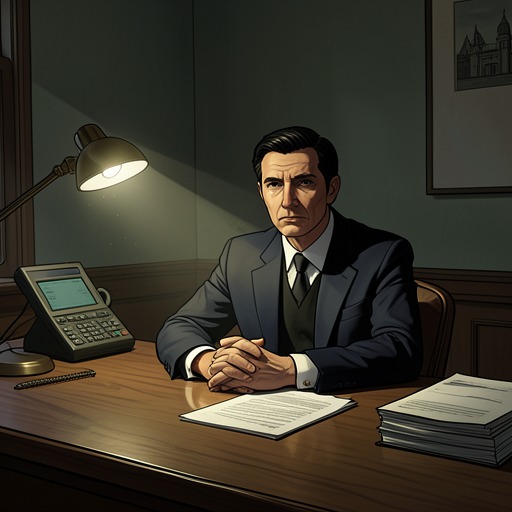
AEC Personnel Security Hearing Board
American PrometheusThe AEC Personnel Security Hearing Board was the panel appointed to judge whether J. Robert Oppenheimer could retain access to classified work. Its 1954 hearing made the boundaries of acceptable scientific dissent part of a security case: Oppenheimer’s past associations and opposition to a hydrogen-bomb crash program were treated as evidence bearing on his trustworthiness. The proceeding’s methods and consequences came to symbolize how an administrative security review could punish political and policy disagreement without the safeguards of a public trial.
Creation and remit
The hearing followed the deterioration of U.S.–Soviet relations and the elevation of officials who supported massive nuclear retaliation. Lewis Strauss, then chairman of the Atomic Energy Commission, appointed the review panel after Oppenheimer refused to resign. The case was not framed as a conventional criminal prosecution. The AEC questioned whether Oppenheimer’s continued employment on its work endangered the common defense and security, and whether it was consistent with national security.
The formal charges gathered together old questions about Oppenheimer’s associations with Communists, his contributions to the Communist Party of California, and the Chevalier affair. They also accused him of persuading other scientists not to work on the hydrogen bomb and of slowing its development. The latter charge connected a dispute over national nuclear policy directly to his eligibility for government service. Earlier, both General Leslie Groves and the AEC had reviewed the association-related information and retained his clearance; the new proceeding gave his opposition to the Super a central place alongside it.
Proceedings and evidentiary limits
The Board’s hearing subjected Oppenheimer’s politics, professional judgments, and personal conduct to intensive scrutiny. The record eventually published as In the Matter of J. Robert Oppenheimer ran to 993 densely printed pages and approximately 750,000 words. Its scale preserved an extraordinary amount of testimony, but the volume of the record did not make the process even-handed: Oppenheimer and his counsel could not see certain FBI reports and other classified material used in the proceedings.
Gordon Gray, associated with the panel as its chair, privately judged that the hearing had been as fair as circumstances permitted, while acknowledging that the defense could not inspect some documents. He was also uncomfortable with the prosecution’s piecemeal, surprise references to documentary material, but concluded that they had caused no damage when the proceedings were viewed as a whole. In private discussions, Gray and other panel members treated Oppenheimer’s tendency to put his own judgment ahead of official decisions as evidence against him. They cited the Chevalier affair, his defense of Bernard Peters, and the hydrogen-bomb debate. This reasoning blurred the distinction between a security threat and an adviser’s disagreement with government policy.
Judgment and public record
The hearing took place amid intense national attention to anti-Communist investigations. While awaiting the panel’s judgment, Oppenheimer and Kitty watched the televised Army–McCarthy hearings, a public spectacle that echoed the atmosphere of his own ordeal. The contrast was sharp: his proceeding had been conducted behind closed doors, with classified evidence inaccessible to the defense, while the televised hearings exposed their participants to a mass audience.
In June, Strauss persuaded the AEC commissioners to publish the hearing transcript, despite the Gray Board’s promise to witnesses that their testimony would remain confidential. The AEC staff highlighted damaging passages for reporters, and conservative commentators used the material to attack Oppenheimer and his supporters. When the Commission’s ruling was announced in the House of Representatives, some congressmen applauded. The Board’s review had thus extended beyond the question of one man’s clearance: its record became an instrument in a public campaign over his reputation.
Consequences and significance
The transcript also exposed the inquisitorial character of the proceedings. Publicity that had been intended to embarrass Oppenheimer helped make him a figure of scientific martyrdom, while the document later damaged Strauss’s own reputation and government career. Henry DeWolf Smyth, who had witnessed the hearing and was the only AEC commissioner to vote to restore Oppenheimer’s clearance, later described the wrong done to him as a stain on the country’s history.
The Board’s significance lay not only in the punishment imposed on Oppenheimer but in the precedent its case represented. Scientists had briefly been treated as public advisers able to speak on the moral and political consequences of nuclear policy. After Oppenheimer’s defeat, dissent from government policy became harder to reconcile with service on advisory bodies: scientists were increasingly confined to providing expertise on narrower technical questions. The hearing marked a watershed in the relationship between scientific advice and state power, showing how the language of security could convert policy disagreement into a test of loyalty.